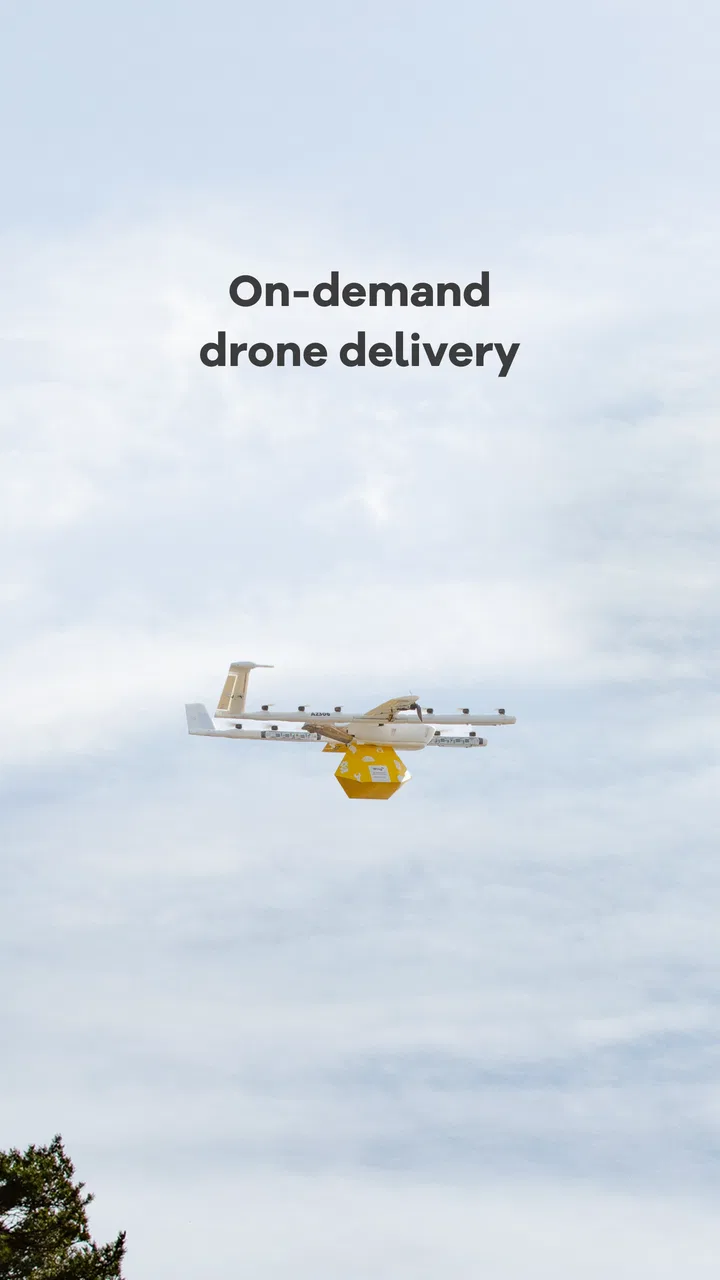
Wing - Drone delivery
- 4.8
- Rating
- 100.00K
- Installs
- Free
- Price

 Analysis by App-foxy
Wing - Drone delivery is the kind of shopping app that makes sense only after you picture a very specific moment: you need a small order, you are at home, and collecting it from a shop would be more effort than the order itself. I found the idea easy to understand, but the real appeal is not novelty alone. It is the possibility of receiving selected goods without arranging a car trip, waiting for a conventional courier, or asking someone else to collect them.
Developed by Wing Aviation LLC, this free shopping app is aimed at ordering drone delivery to a home. It has a 4.6 average from around three thousand ratings, with more than one hundred thousand installs, which suggests that the concept has moved beyond a simple experiment for curious early adopters. The age rating is Everyone, and the app was released in June 2021. Those details matter because this is not presented as a specialist tool for pilots or logistics workers; it is a consumer-facing way to place an order.
How Wing feels to use in everyday situations
I find Wing easiest to judge by looking beyond the novelty of a drone and focusing on what the delivery changes: a small shopping task may no longer require leaving home. In the sections that follow, I’ll consider how that option fits into ordinary routines, then weigh the practical conditions that make it useful—or make a familiar delivery method the wiser choice.
You May Also Like

 AccuWeather: Weather Radar
AccuWeather Review: A Quick, Clear Forecast for Everyday Decisions
For everyday plans, the best forecast is the one you can understand quickly. AccuWeather makes rain timing, radar, and local conditions easy to act on, with a few trade-offs.

 Hill Climb Racing
Why Hill Climb Racing Still Turns Crashes Into One More Run
A tiny car, a bumpy hill and one more upgrade: Hill Climb Racing keeps resurfacing because its simple chaos makes every near-miss feel personal.

 AliExpress - Shopping App
AliExpress Makes Global Shopping Feel Personal, but Shoppers Bear the Risk
AliExpress turns a global marketplace into a pocket-sized discovery engine. Its reach is useful, its shopping loop compelling, and its trade-offs easy to miss.

 Lords Mobile: Kingdom Wars
Lords Mobile Is a Kingdom-Building Routine, Not a Quick Match
A case-by-case verdict on the building, battles, device demands, and social commitments that make Lords Mobile rewarding for some players and exhausting for others.

 PDF Scanner app - TapScanner
TapScanner Makes Paperwork Easier to Capture, Check, and Share
TapScanner makes scanning with a phone feel less like a rescue operation and more like a dependable step in getting work done. Its capture tools are useful, though not flawless.

 Block Blast!
 Shows How Much a Puzzle Game Can Leave Out
A quiet grid game shows why puzzle players increasingly value instant clarity, repeatable skill and low-pressure play—and where the genre still needs to catch up.
More From Our News Desk
View All News


Readability and navigation
My first impression was that the service is easier to understand than many delivery apps because the central action is so clear: choose something available, provide the delivery information, and wait for it to arrive. There is less mental clutter than in a broad marketplace that mixes restaurants, supermarkets, pharmacies, retailers, promotions, subscriptions, and several delivery methods on one screen.
That simplicity is helpful for people who prefer a short, predictable path through an app. Someone who finds dense menus tiring can focus on the items and the delivery process rather than learning a large shopping platform. The wording also benefits from being concrete. A drone delivery service has a defined purpose, so the user is not left wondering whether the app is mainly for browsing, coupons, store collection, or traditional courier delivery.
I would still approach the app with the same care I use for any location-based shopping service. Before placing an order, I would check the delivery address, review the available items, and make sure the chosen drop-off point is practical. A clean interface cannot remove the need to read order details. Users with low vision, reading difficulties, or attention-related challenges may appreciate a focused workflow, but they should not assume that every part of the experience will be equally comfortable on every phone.
One useful habit is to decide where the package should be received before starting the order. Drone delivery is different from a person handing something to you at a door, so thinking about the landing or drop-off area first reduces last-minute confusion. A visible, reachable place is more useful than choosing a location merely because it is close to the front entrance.
Motor and sensory considerations
The strongest accessibility benefit is practical rather than technical: the service can reduce the physical work involved in obtaining a small purchase. If walking to a shop, driving, carrying a bag, or coordinating a pickup is difficult, bringing an order closer to home may make a meaningful difference. That could help someone recovering from an injury, a parent managing a sleeping child, or a person whose energy varies from day to day.
It can also support people who find busy shops overwhelming. Avoiding traffic, queues, bright retail spaces, and crowded aisles may make a simple purchase less stressful. In that sense, Wing is not only competing with other delivery apps; it is also offering an alternative to entering a physical store at all.
There is a trade-off for people with hearing or sensory sensitivities. A drone arriving near the home may produce sound and movement that are more noticeable than a standard package left by a courier. Someone who is sensitive to unexpected noise may prefer to know when the delivery is approaching and have a quiet, prepared routine for collecting it. I would not treat the aerial method as automatically calmer just because it avoids a shop.
The same applies to users with limited dexterity. The app may reduce the need to carry goods over a longer distance, but the final collection still needs to be manageable. If the delivery point is awkward, low, obstructed, or outside a safe path, the convenience can disappear. A family member, support worker, or housemate may need to help with retrieval, especially when the order is bulky or the user cannot move quickly.
The important distinction is that Wing can reduce travel effort without eliminating every physical step. It is best viewed as a shorter access route to a purchase, not as a completely hands-free service.
Situational access: where the app makes the most sense
The most convincing use case for me is a small, time-sensitive household need. Imagine realizing that you are missing an everyday item while caring for a child, working from home, or dealing with poor weather. A normal shopping trip would involve stopping what you are doing, getting ready, traveling, finding the item, and returning. If the product is available through Wing and your home can receive the delivery, the app may turn that interruption into a much smaller task.
It is also useful for people who cannot easily drive. A conventional delivery service may remain the better option for a large grocery order, but a drone can be appealing when only a few items are needed. The smaller scale is part of the point: you are not replacing every shopping trip, but you may avoid a frustrating trip for one or two things.
Another less obvious situation is shared housing or a busy family home. A carefully chosen receiving spot can prevent a delivery from being left in a place where someone might trip over it or mistake it for rubbish. I would tell anyone in this situation to agree on one visible collection area with the people they live with. That small bit of preparation makes the service easier to use and reduces the chance of a package being moved before the intended recipient sees it.
Wing is less attractive when the order requires personal advice, careful inspection, or a wide choice of alternatives. In a physical shop, I can compare sizes, ask an employee a question, or change my mind after seeing the product. A drone delivery is more suitable when I already know what I want and the available selection is enough. For a major grocery shop, a traditional supermarket delivery may be more efficient because it can handle a larger basket in one visit.
The service also depends on the home environment. Apartment residents, people in dense buildings, and users without a clear outdoor receiving area may need to think more carefully about whether the delivery can be collected safely. A house with an accessible open area is a more natural fit than a location where balconies, shared entrances, trees, overhead structures, or locked access complicate the final step. I would not choose the app solely because the idea sounds convenient; I would first judge the route from the receiving point to the place where I will use the item.
What makes it different from ordinary shopping apps
Compared with a conventional shopping app, Wing puts the delivery method at the center of the experience. That changes how I evaluate it. With a normal marketplace, I usually ask how broad the catalog is, how well search works, and whether I can combine products from several sellers. Here, the more important question is whether the available selection matches a quick local need and whether the delivery format suits my home.
Compared with a standard courier, the advantage is the possibility of a short, direct trip from a nearby source to the receiving area. The limitation is that this format is naturally less flexible than a person who can carry a larger parcel to a precise doorway, speak with the recipient, or adapt to an unexpected obstacle. If I need a large basket, a signature exchange, or help bringing something indoors, I would favor a conventional delivery service.
Compared with going to a store, Wing saves travel and can reduce exposure to crowded environments. The cost of that convenience is less control over the final handoff and potentially less freedom to browse. That is why I see it as a complementary shopping option rather than a universal replacement.
Remaining barriers and small frictions
The biggest barrier is not learning the app; it is matching the service to the physical setting. A person may be perfectly comfortable navigating the order process but still struggle to reach the delivery point. Before relying on it, I would consider lighting, surface quality, weather, door access, and whether another person can retrieve the package if needed.
There is also a planning burden that is easy to overlook. A conventional courier can often leave a parcel at a door, while a drone-based order makes the receiving area more central to the experience. Users with mobility limitations should plan for the final few meters, not just the distance saved by avoiding a shop. For someone who uses a wheelchair, walker, cane, or mobility scooter, a clear route is more important than an attractive but hard-to-reach location.
People with visual impairments may want assistance selecting the receiving area and identifying the package once it arrives. People with hearing loss may prefer visual checks rather than relying on an audible arrival cue. People with cognitive disabilities may benefit from a simple routine: place the order, note the expected delivery information, keep the receiving area clear, and collect the item immediately. These are practical adaptations, not claims that the app provides specialized accessibility tools.
The free price removes one obvious reason not to try it, but free access does not guarantee that every order will be the best value for every situation. I would compare the total ordering experience with a normal delivery or store trip, especially when I need several items. A small order can be convenient because it avoids a journey; a larger order may be better handled by a service built around carrying more goods at once.
Another limitation is emotional comfort. Some users may enjoy watching a drone arrive, while others may dislike the noise, visibility, or uncertainty of an aerial delivery near their home. If an unexpected arrival would disturb pets, children, neighbors, or someone with sensory sensitivities, I would prepare the household first or choose another delivery method.
Who should try it, and who should skip it
I would recommend Wing to people who regularly need small purchases, live in a suitable delivery area, and value avoiding a short but inconvenient trip. It is particularly promising for home workers, caregivers, people with fluctuating mobility, and anyone who finds crowded shops difficult. The app is also a good fit for users who already know what they want and prefer a focused order rather than a long browsing session.
I would be more cautious about recommending it to someone who needs large quantities, wants to inspect products personally, or cannot safely reach an outdoor receiving point. It is also not my first choice for a user who needs a human handoff or assistance carrying an order inside. In those cases, a regular courier, store delivery, or help from another person may offer better practical access.
For a first order, I would choose something familiar rather than an urgent or essential item. That lets me learn how the app presents the order, how the receiving process fits my home, and whether the final collection is comfortable. Once that routine works, Wing becomes easier to judge on convenience rather than curiosity.
My inclusive verdict
Wing stands out because it treats delivery as a way to remove travel from a small shopping task. I found that especially valuable when access to a store is tiring, complicated, or simply not worth the effort for one item. Its focused purpose makes the idea easy to grasp, and the free app is approachable for ordinary shoppers rather than only technology enthusiasts.
Its inclusive value has clear limits. The app can shorten the journey, but it does not automatically solve the accessibility of the home, the receiving area, the package, or the final collection. Noise, outdoor access, weather, building layout, and the need for human assistance all matter. Those details should be part of the decision before an order is placed.
My final view is positive, with a specific recommendation: use Wing when you need a relatively small purchase, already know what you want, and can prepare a safe, reachable receiving spot. Choose a conventional store or courier when you need a large order, personal assistance, product comparison, or a dependable handoff at the door. For the right household, the app is more than a novelty. It is a practical way to make one kind of shopping less demanding, provided the last step is planned with the same care as the order itself.
With its Everyone age rating, established presence since June 2021, and strong user response, Wing - Drone delivery is worth considering as a focused shopping tool rather than a replacement for every delivery service. I would recommend trying it for a low-pressure order and judging it by the complete experience: reading the choices, placing the order, receiving it, and getting the item safely inside.
FAQs for Wing - Drone delivery
01What is Wing and how does it work for drone delivery?
Wing is a cutting-edge drone delivery service that allows users to receive packages quickly and efficiently via autonomous drones. After placing an order through the app, a drone is dispatched to deliver the item directly to your location. The service leverages advanced navigation and safety features to ensure speedy and secure deliveries.
02Is the Wing app available on both Android and iOS platforms?
Yes, the Wing app is available for download on both Android and iOS devices. Users can find it on the Google Play Store and the Apple App Store, making it accessible to a wide audience. The app provides a seamless user experience across both platforms, ensuring easy access to drone delivery services.
03What safety measures does Wing implement for its drone deliveries?
Wing employs a variety of safety measures to ensure secure drone operations. Each drone is equipped with advanced navigation systems to avoid obstacles and follow designated flight paths. Additionally, Wing conducts regular maintenance and safety checks on its fleet and complies with aviation regulations to protect both users and the environment.
04How fast can I expect a delivery from Wing after placing an order?
Once an order is placed, Wing aims to deliver the package within minutes, depending on your location and the item’s availability. The drones are designed to operate efficiently, reducing wait times significantly compared to traditional delivery methods. Real-time tracking in the app provides updates on your delivery status.
05What types of products can be delivered using Wing's drone service?
Wing's drone delivery service is suitable for a variety of products, including small packages, food items, and essential goods. However, there are restrictions on weight and size to ensure safe flight operations. The app provides a list of available products, so users can easily choose items eligible for drone delivery.
Pros
- Fast delivery times for urgent needs.
- User-friendly interface for easy navigation.
- Real-time tracking of your deliveries.
- Environmentally friendly option.
- Wide delivery coverage area.
Cons
- Limited to certain geographical regions.
- Requires stable internet connection.
- Weather conditions can affect service.
- Higher cost compared to traditional delivery.
- Limited payload capacity for larger items.

Wing - Drone delivery
Gallery